Tuesday, February 5, 2008

Data

I wanted to share a little bit from the UNFPA website. For those not familiar with the United Nations Population Fund, this is their mission statement:

UNFPA, the United Nations Population Fund, is an international development agency that promotes the right of every woman, man and child to enjoy a life of health and equal opportunity. UNFPA supports countries in using population data for policies and programmes to reduce poverty and to ensure that every pregnancy is wanted, every birth is safe, every young person is free of HIV/AIDS, and every girl and woman is treated with dignity and respect.


I wanted to share a little bit of background info on some of the problems of getting women proper care during childbirth. I found some of these statistics to be quite shocking. Again, from the UNFPA site.

The limitations of screening to identify risks

Some women may clearly be at risk for complications, such as those with obvious physical malformations or very short stature, those that are too young and immature, or those having severe health conditions. It is indeed essential to refer them to an institution before the start of the labour, in order to anticipate and manage obstetric complications. But the great majority of complications arise with little or no warning among women who have no risk factors. Every minute, 110 women in the world experience a complication in their pregnancy, and one of them will die.

Since it is difficult to predict who will develop a life-threatening complication, all pregnant women should have access to a qualified health provider for prenatal and delivery care, operating in a health centre with adequate referral services to a higher level of facility if needed.

Impoverished and rural women get less care

Over the last 15 years, all regions have shown improvement in the proportion of assisted births, from 43 per cent for the developing world as a whole in 1990 to about 58 per cent. Eastern and South-East Asia and Northern Africa have made the most headway. In sub-Saharan Africa, where nearly half of the world's maternal deaths occur, only 46 per cent of deliveries are assisted by skilled attendants. In Southern Asia, the proportion is even lower.

Enormous disparities remain within countries: Impoverished and rural women are far less likely than their urban or wealthier counterparts to receive skilled care during childbirth. In rural areas health clinics and hospitals are often spread out over vast distances and transportation systems are often rudimentary. That is one of the reasons why UNFPA supports increasing the number of community-based midwives, and strengthening district-level health systems to provide backup support.


Some of the data I've seen in the area of Zambia we are working with is quite shocking. A Zambian Demographic Health Survey in 2001-2002 showed that nationally only 43.4% of women had their last delivery with a skilled provider. In the Central Province (where we are working) only 34.2% had. That means that over 65% of women are delivering their babies away from a skilled attendant! That would explain one reason why the maternal and infant mortality rate is so high.

Saturday, February 2, 2008

Bus Convienence Store


Here is a picture of the bus in Kapiri. I just love the way once a bus stops in town women pick up their good and rush to the windows to try to sell you various foods.

Friday, February 1, 2008

Zambian Sky


Here is an example of the beautiful sky I keep talking about. Because it rains and then stops, and then rains again the sky is constantly changing which is why I can't stop looking at it. If you click on the photo it will blow up so you can get a better look.

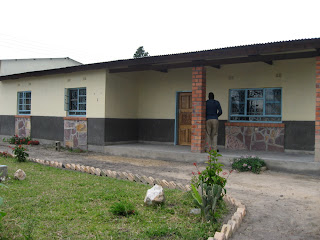
This picture was taken in front of our house in Kapiri Mposhi. I'm standing in the street right in front of our driveway. I've also included a pic of the house itself.

Also a funny story from today. I was waiting for the bus back down to Lusaka from Kabwe, and there were a bunch of women in fairly traditional African dress all bobbing their heads a little bit to Justin Timberlake that was blasting from a store. It seemed so out of place I couldn't help but watch for a bit.

Thursday, January 31, 2008

Women's Group Meeting


Yesterday we went to Mukonchi Rural Health Center and met with about 15 women to ask what THEY would like in a waiting house. When we build this we want to do it right and give them what they want and not tell them the way it is going to be.

Overall they really like the idea of the waiting house, they say that they would like to come about 2 weeks before their expected date of delivery so that they are able to travel more easily. They also feel that they and many other women will be much more likely to seek their help with delivery if they can come 2 weeks early rather than just a couple of days. The whole point of the waiting house is to build a place where expecting mothers can come and wait before their delivery so they will have access to medical care when the big moment arrives.

Then we got asked the tough questions. First, they wanted to know if there would be any transportation to bring them to the waiting house, I managed to dodge the bullet by saying that at this point we weren't sure what else we could offer in ways of transportation. But then the big question was asked by a woman who was very quiet the whole meeting. She raised her hand at the end and simply asked if there would be a way to get them to the hospital in Kabwe if there were any complications. Every woman in that room nodded and was very concerned about this issue. Let me explain why.

If a woman is at this health center and suddenly there is a complication, right now they have to wait for the one ambulance in Kapiri to come get them (which would take an hour, and that is if it was available and had fuel) and then take another 1.5 hours to get to Kabwe hospital. When I asked Marion (our OB) what the standard is in the U.S to get a woman in for a C-Section as soon as a complication is discovered and she told me it was 30 minutes. Now, add in the fact of the matter is that nobody can count on the ambulance and what happens is that the women are left to find their own transportation while they are in labor with complications. This would cost them about $25, which nobody has. So they are forced to sell off their livelihoods (cattle, chickens, goods, whatever they have) in order to save their and their baby's life. And still, it's going to take hours to get them to the hospital as the road is terrible. We timed it out yesterday, took us 1.5 hours to travel 50 km. I believe it's 8 km per 5 miles, so I'll let you guys figure out the math.

I sometimes wonder if would could do more by paving the road instead.

Sunday, January 27, 2008

Lazy Weekend

The weekend was a lazy one. Yesterday I took part in the Hash, which is a running club that is unlike any other running club I've ever seen or heard of. They are called the Hash House Harriers. Yes, there was a bugle, lots of shouting, and plenty of beer at the end. That was the most fun I've had exercising since high school softball! I hope to go more often.

I moved into the guest house today in Lusaka, and I'll be up in Kapiri for a few days this week setting up the house. I ran into one of the guys from the MSF (Medecins Sans Frontieres) house yesterday at the big month end market that I had previously met up in Kapiri. We are going to get together this week once I go up, and hopefully he'll give me some more info on the area.

Thursday, January 24, 2008

Another Day

Today we decided to look for some alternate housing in Kabwe. It was not that pretty. Our house in Kapiri is now looking a lot more attractive. We hired some guards for the day and night from a security company. We did that the smart way by sending in our driver to get some quotes and he was actually able to negotiate a deal that would save us 100,000 Kwacha/month! I'm sure they would have elevated the prices a bit had I walked in and tried to set things up. I just hope they weren't disappointed when I walked in to sign the papers.

Marion and Jason spent about 3 hours in Kapiri Mposhi Hospital today and seemed to be pretty jazzed about what they saw. I noticed another WFP (World Food Program) truck load outside the Kapiri District Health Office. I wonder how often they are getting shipments, and I wonder where they are getting dispersed to.

I'm starting to really think about how we are going to get women into the rural clinics. Thoughts were to give out incentives for women coming in. The question is whether it is better to get the incentives (let's say a blanket) donated and just hand them out? Or would it be better to get a bunch of the local women involved in making the blankets, and they buying them back from them to give out. It would give a few jobs, some confidence, and maybe spread the word more if women in the communities were actually making whatever it is we would give out. But would that be too difficult logistically to get up and running right away? Would it be better to bring in outside resources and eventually shift to local women making things??

Thoughts??

Wednesday, January 23, 2008

Beautiful Babies


This is why I'm here. Just look at those cheeks! This woman was waiting in line to have her baby weighed to see how she was doing on the growth charts. This is one thing done on antenatal clinic day. The women were so happy to see themselves and their babies on my camera after I took their pictures. I hope to print them out and bring them with me to the clinic so they can have the pictures.

Looking at all these babies I can't help but wonder which ones will survive. When at Kapiri hospital I was told that 1/2 to 3/4 of the admissions are HIV/AIDS complications. Throw in some malaria, TB and malnutrition and these babies have a lot working against them.